May 2026 - Normalizing Innovation
The Logical Way To Achieve… Nothing Special.
Over the past few months, we’ve talked about orientation, action, perspective, signals, and the importance of trusting what you notice before it becomes obvious.
This month, I want to talk about something quieter. Something far more subtle. Something that quietly reshapes innovation inside organizations every single day.
Normalization.
Not the healthy kind that creates stability and consistency.
The other kind.
The kind that takes something unfamiliar, unconventional, or potentially disruptive… and slowly reshapes it into something easier to understand, easier to explain, easier to approve, and easier to fit into the current environment.
By the time the process is complete, the idea still exists… Technically.
It just no longer changes anything.
What Organizations Say They Want
Most organizations say they want innovation.
They hold brainstorming sessions. Launch innovation initiatives. Celebrate creativity. Encourage teams to “think outside the box.”
And then, almost immediately, the pressure begins.
How would this work within our current structure? Who already does something similar? Can we make it feel more familiar? Can we reduce the risk? Can we simplify the messaging? Can we align it with what leadership already understands?
None of these questions are unreasonable.
That’s what makes this so dangerous.
How Unfamiliar Ideas Enter the Room
Innovation rarely arrives polished.
It doesn’t show up with a complete roadmap, universal buy-in, and a PowerPoint deck that makes everyone comfortable.
Real innovation often arrives incomplete. Awkward. Slightly inconvenient. Difficult to categorize.
Sometimes it sounds unrealistic. Sometimes it feels disconnected from the current business model. Sometimes it challenges assumptions that have produced success for years.
And because humans naturally seek coherence, we instinctively begin reshaping unfamiliar ideas into something more understandable.
Something more manageable.
Something safer.
The Sanitization Process

That reshaping process happens everywhere.
A bold idea enters a meeting.
Someone asks for clarification. Another person reframes it through the lens of existing strategy. A third person simplifies it so it’s easier to communicate. A fourth asks how competitors are approaching it.
By the end of the conversation, the original insight has been translated four different times.
Each step sounds logical. Responsible, even.
But every interpretation pulls the idea slightly closer to what the organization already knows how to accept.
And eventually, the unfamiliar (innovative) edge disappears.
Iteration Wrapped in Innovation
This is one of the reasons so many companies proudly announce “innovation” while delivering little more than polished iteration.
New packaging.
New language.
Incremental improvements.
Slightly better versions of existing models.
There’s nothing inherently wrong with iteration.
Iteration matters. Operational excellence matters. Continuous improvement matters.
But let’s not confuse refinement with reinvention.
They are not the same thing.
When the Future Gets Interpreted Through the Past

One of the most fascinating examples of this tension came from the early days of streaming media.
Long before streaming became dominant, many media companies already possessed the technology, infrastructure, and customer base to begin moving in that direction.
The signals were visible.
Consumer behavior was shifting.
Digital consumption was accelerating.
Bandwidth capabilities were improving.
The possibility existed.
But many organizations interpreted streaming through the assumptions of their current business model instead of through the lens of where behavior was heading.
The unfamiliar future kept getting translated into familiar terms.
Existing pricing structures.
Existing distribution models.
Existing assumptions about customer behavior.
The technology wasn’t the biggest obstacle.
Perspective was.
The Invisible Filters Inside Organizations
This happens inside leadership teams constantly.
A new idea gets evaluated based on how well it fits the current environment instead of whether the current environment itself may need to evolve.
A signal from outside the industry gets dismissed because it doesn’t map neatly to existing metrics.
An unconventional perspective gets watered down until it feels easier to support internally.
Not because people are unintelligent. Not because they fear innovation. Because normalization feels productive.
It creates alignment. It reduces tension. It speeds up decision-making. And in stable environments, that approach can work reasonably well.
But the environment we’re operating in right now is not stable. Markets are shifting faster. Technology is accelerating faster. Consumer expectations are evolving faster. AI is compressing timelines across nearly every industry.
Advantage windows are shrinking. The distance between “interesting idea” and “industry standard” has never been shorter.
Which means organizations no longer have the luxury of slowly reshaping every unconventional idea into something comfortable before acting on it.
Protecting Possibility Before Consensus
This creates a difficult leadership challenge.
How do you evaluate unfamiliar ideas without immediately forcing them into familiar frameworks?
How do you protect unconventional thinking long enough to understand its potential?
How do you create environments where unusual perspectives are explored before they are normalized?
Those are perception questions.
The leaders and organizations that navigate this era successfully will not be the ones generating the highest volume of ideas.
They will be the ones capable of preserving unconventional value long enough to recognize what makes it valuable in the first place.
That requires patience. Curiosity. Tolerance for ambiguity. And perhaps most importantly… the willingness to sit with something that doesn’t fully make sense yet.
The Quiet Pressure Toward Familiarity
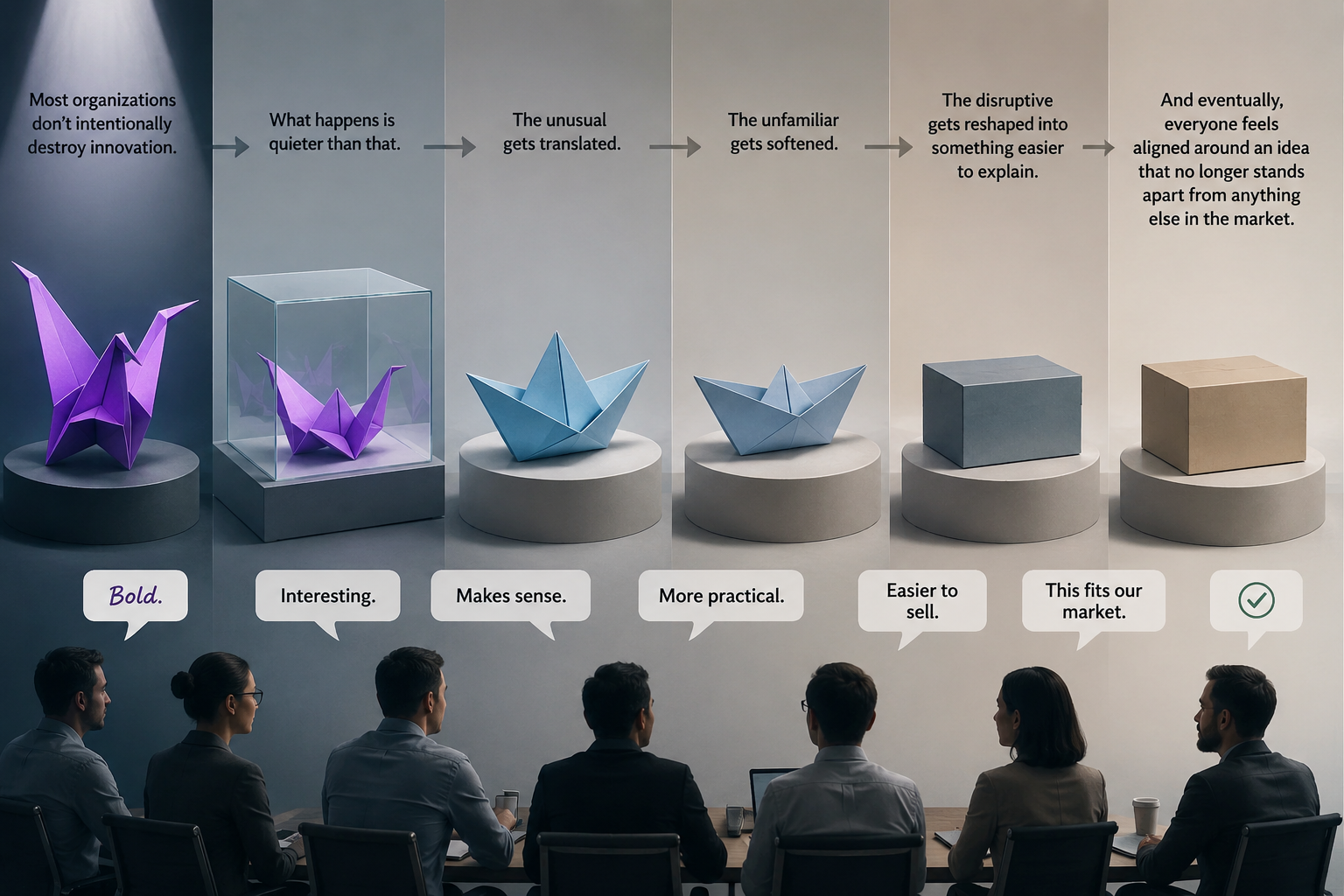
Most organizations don’t intentionally destroy innovation.
What happens is quieter than that.
The unusual gets translated. The unfamiliar gets softened. The disruptive gets reshaped into something easier to explain.
And eventually, everyone feels aligned around an idea that no longer stands apart from anything else in the market.
Before the Idea Gets Sanitized
The pressure to normalize is deeply human. We all do it.
The unfamiliar creates tension. Explanation reduces tension. Consensus rewards familiarity.
But innovation has never been born from consensus alone. At some point, leaders must decide whether they want ideas that feel comfortable internally… or ideas that create logical (on-brand) distinction externally.
Because those are not always the same thing.
The world is not slowing down so organizations can become more comfortable with change. If anything, the opposite is happening.
Which means the ability to recognize, protect, and explore unconventional ideas before they become sanitized may become one of the defining leadership advantages of the next decade.
Not every unusual idea deserves pursuit. But every unusual idea deserves more than immediate normalization.

Before your next meeting, strategy session, or brainstorming conversation, pay attention to something subtle:
Watch how quickly unfamiliar ideas get translated into familiar language.
Watch how quickly unconventional thinking gets reshaped into something safer.
Watch how often organizations ask: “How do we make this fit?”
before asking: “What makes this different?”
That small shift in awareness may reveal more about your organization’s relationship with innovation than any mission statement ever will.
♻️ Share this with someone who could use a less "normalized" understanding of innovation.
🔔 Follow me, Paul Daniels, Jr., for Peripheral Thinking™ insights M-F.
Until next time... I'll be looking for you in the periphery!
One More Thing(s)
🧠 Rent My Brain.
This isn’t your typical consulting, coaching, or workshop engagement. Rent my Peripheral Thinking™ brain for a few hours. Whatever is top of mind or that persistent issue. We’ll talk, and I’ll do the Peripheral Thinking for you.
Click the link, select “Advisory,” fill in the fields, and I’ll contact you.
🎤 Book A Keynote.
From executive retreats to 10,000-attendee conferences... Always personalized for your audience and packed with Peripheral Thinking™ skills and tools to use that day and every day after!
Let’s discuss how I can make your event the one people talk about for years.
© 2026 Paul Daniels, Jr & Peripheral Thinkers™ | Image Credits: Image Creators.