July 2026 - Learning to Read the World Differently
"Education is not the learning of facts, but the training of the mind to think."
— often attributed to Albert Einstein
Think back to when you first learned to read.
At first, every page looked like a collection of unrelated marks. Someone patiently taught you that individual letters formed words. Words formed sentences. Sentences carried ideas. Eventually, something remarkable happened.
You stopped seeing ink.
You began seeing meaning.
Reading became so natural that you no longer thought about the process.
What if innovation begins the same way?
Not by learning to read books.
By learning to read the world.
A few days ago, during one of my shifts at a home improvement store, a young woman and her younger brother approached me with an armful of springs, screws, rope, and miscellaneous hardware they had collected from several aisles.
She held up a small package of rope.
"What do you think about this?"
I have to admit, my first thoughts weren't especially profound.
It's colorful.
It's inexpensive.
It's... rope.
Instead of answering, I asked the question I've learned opens far better conversations.
"What project are you working on?"
Before his sister could answer, her younger brother smiled and said,
"We're building a bow and arrow set."
Now they had my full attention.
She pulled out her phone and showed me a YouTube video of a design I'd never seen before. As the video played, my mind immediately began assembling the project. I wasn't simply watching someone build a bow. I was mentally identifying components, anticipating challenges, considering alternative materials, and imagining different ways to improve the design.
As we talked through the project, the young inventor said something that made me stop.
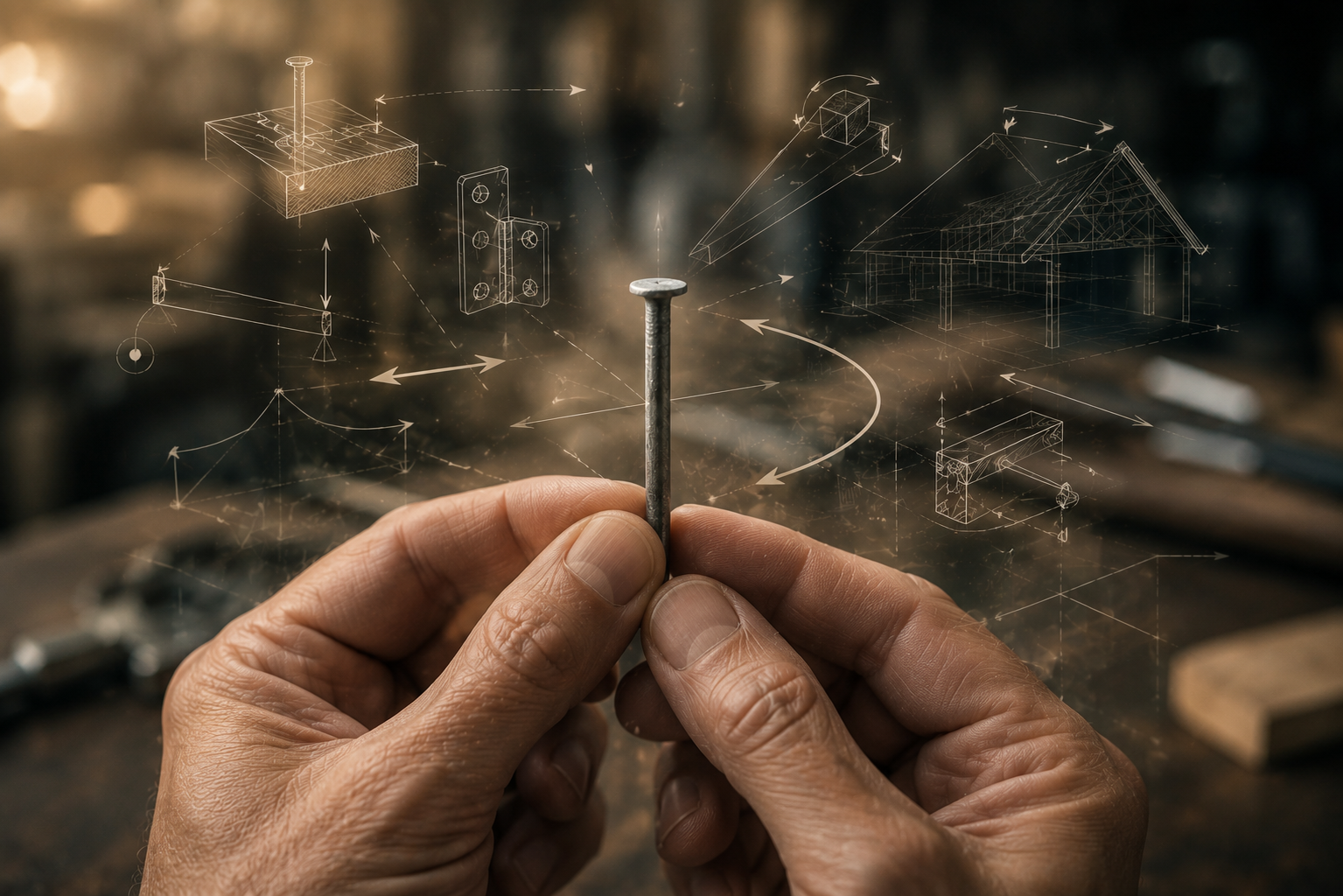
"I'm worried about using nails on the hinged pieces. They create too much friction."
"Exactly," I replied.
Then he continued.
"Nails are designed to fasten things together using friction."
I couldn't help but smile.
This young man wasn't looking at a nail.
He was reading a principle.
He understood not just what a nail was.
He understood why it worked.
That changes everything.
One of the great misconceptions about innovation is that innovative people somehow see a different world than everyone else.
I don't believe that's true.
I think they learn to read the same world differently.
Most people see products.
Peripheral Thinkers read possibilities.
Most people see objects.
Peripheral Thinkers read functions.
Most people see industries.
Peripheral Thinkers read transferable principles.
Most people see obstacles.
Peripheral Thinkers read opportunities hiding inside constraints.
The world hasn't changed.
The interpretation has.
As we continued walking through the store together, something else caught my attention.
Neither the brother nor his sister seemed concerned that they didn't know the names of every part they needed.
They weren't embarrassed to ask questions.
They didn't pretend to know.
They simply believed that somewhere inside this enormous store were all the pieces necessary to bring their idea to life.
They didn't know exactly where those pieces were.
They didn't know all their names.
But they believed they existed.
That realization stayed with me long after they left.
Over the past six months, we've explored Peripheral Thinking™ together.
We've discussed curiosity.
Perspective.
Trusting your observations.
Protecting uncommon ideas.
Studying environments.
Looking beyond the obvious.
At first, those may have felt like individual lessons.
They weren't.
You've been learning a new literacy.
Every Peripheral Thinking skill teaches you to read another layer of the world.
Studying helps you read beyond your industry.
Surveying helps you read the broader environment.
Deciphering helps you read the principles beneath complexity.
Investigating helps you read beyond the first answer.
Reimagining helps you read relationships others overlook.
Creating helps you assemble those discoveries into something that didn't previously exist.
The skills aren't simply techniques.
They're new ways of interpreting reality.

Perhaps that's why one of the simplest ideas in Peripheral Thinking™ has become one of my favorites:
Right now, you can access everything you need to achieve anything imaginable.
Not because you already possess every resource.
Not because success is guaranteed.
Not because every opportunity will be easy.
Because the world is already full of experiences, conversations, principles, people, frustrations, ideas, and opportunities waiting to be recognized, connected, and assembled.
The challenge isn't their absence.
It's our ability to read them.
That young brother and sister reminded me of something I hope I never lose.
Builders don't begin with certainty.
They begin with possibility.
They walk into unfamiliar territory believing the pieces exist.
Then they ask questions.
They experiment.
They learn.
They adjust.
They build.
That may be one of the most important mindsets a leader can develop.
Not certainty.
Confidence that the next piece can be found.
As I watched them leave, I asked if they would come back and show me a video of their finished project.
I genuinely hope they do.
Not because I'm curious whether the bow works.
I'm confident they'll figure that out.
I'm curious to see what two people can build when they believe the world is filled with pieces waiting to be discovered.
That's the mindset that has built remarkable companies.
Advanced medicine.
Life-changing technologies.
Entire industries.
It rarely begins with having all the answers.
It begins with believing the answers can be found.
As we begin the second half of this year together, I'd encourage you to practice reading the world a little differently.
Read the conversations you're having.
Read the frustrations customers quietly accept.
Read the assumptions no one questions.
Read the experiences that seem too ordinary to matter.
Read beyond the obvious function of the tools already in your hands.
You may discover that the components of your next opportunity have been surrounding you all along.
You simply hadn't learned to read them yet.
Until next month...
Keep reading.
I'll be looking for you in the periphery.
-Paul-
ONE MORE THING(s)…
Thank you!
To first-time readers and long-time supporters.
Thank you for your comments.
Thank you for your disagreements.
Thank you for your perspectives, insights, and willingness to try new things.
This newsletter is and will always be about and for you.
THANK YOU!
Peripheral Thinking™ and Peripheral Thinkers™ are protected trademarks.
Image Credit: Image Creators | © 2026 Paul Daniels, Jr. & Peripheral Thinkers™